
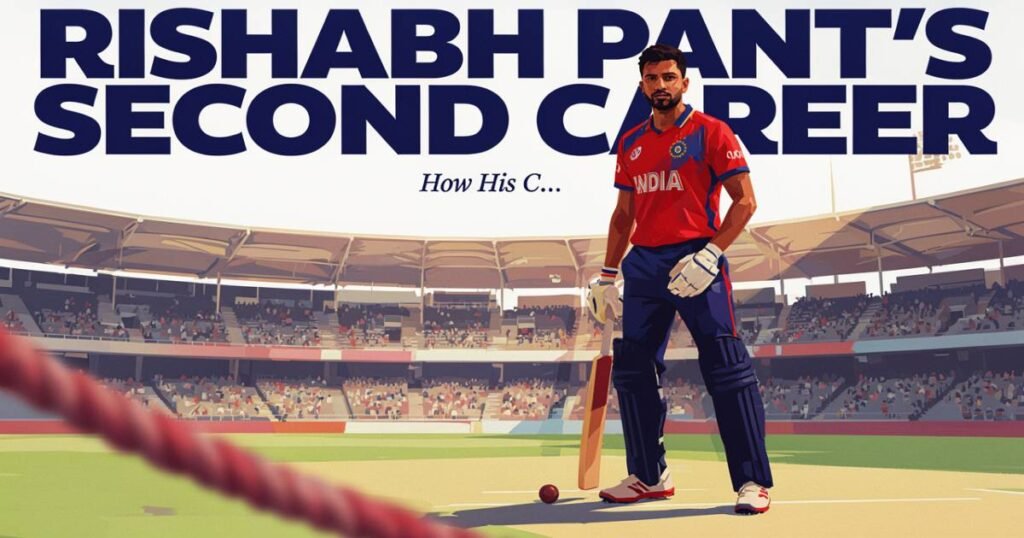
Rishabh Pant’s career can be divided into two periods: before December 2022 and after it. Before his car accident, he was primarily discussed as a wicketkeeper-batter whose methods challenged conventional ideas about Test batting. His shot selection produced victories but also criticism. After surviving the crash, undergoing surgery, completing rehabilitation, and returning to international cricket, the same player began to be viewed through a different lens. His performances were no longer separated from the fact that playing again had once been uncertain.
A comeback of this scale also changes the way audiences interpret uncertainty. Before the accident, Pant’s risk-taking could frustrate supporters because every unconventional stroke appeared to create an avoidable possibility of dismissal; after his return, even digital searches unrelated to cricket, such as adventures beyond wonderland game login, underline how modern audiences move between entertainment built around unpredictable outcomes. In Pant’s case, however, uncertainty became personal: fans had watched his career stop without knowing whether it would restart.
Before the Accident: Talent Mixed With Debate
Pant had already built a substantial international reputation before the crash. His Test batting was particularly difficult to classify because he could defend for periods and then attack without following the expected progression of an innings.
That approach produced important performances outside India. His unbeaten 89 at Brisbane in January 2021 helped India complete a chase of 328 and secure a series victory in Australia.
Yet the same instincts could lead to dismissals that generated criticism. When an attacking shot failed, discussion often focused on whether Pant had misunderstood the situation.
This created a recurring debate around him. Supporters valued his capacity to change a match quickly, while critics questioned whether his decisions created unnecessary risk.
See Also: Peter Doocy Wife Illness: Facts, Rumors & Health Update in 2026
The Accident Changed the Context
Pant was involved in a car crash in December 2022 while travelling in northern India. The injuries removed cricket from the immediate discussion.
The priority became recovery.
He required medical treatment and surgery before beginning a rehabilitation process that involved rebuilding mobility, strength, and cricket-specific movement.
For a wicketkeeper, this challenge was significant. Keeping requires repeated squatting, lateral movement, rapid changes of direction, and explosive reactions. Batting adds running, rotation, and the impact created when playing shots.
His recovery therefore had to restore more than the ability to walk or run. He needed enough physical capacity to perform two roles at professional level.
Why the Long Absence Changed Fan Perception
Athletes are usually judged through immediate results. A low score can dominate discussion for several days before another match replaces it.
Pant’s absence interrupted that cycle.
Without new innings to evaluate, supporters were reminded of what India had lost tactically. His ability to attack from the middle order was difficult to reproduce, particularly in Test cricket.
The accident also changed the emotional context around his career. Actions previously described as reckless on the field could now be interpreted as part of the competitive instinct that made him distinctive.
This did not make every cricketing decision correct. It changed the framework through which those decisions were viewed.
The question became less about why Pant did not bat like a conventional wicketkeeper and more about what India gained from allowing him to remain himself.
The Return Required More Than Fitness
Pant returned to competitive cricket in 2024, more than a year after the accident.
Simply appearing in professional competition represented one stage of the comeback, but returning to international standards required another.
Match fitness cannot be recreated entirely in rehabilitation. A batter needs to judge pace, length, and movement under pressure. A wicketkeeper needs to react to edges and changes in trajectory without conscious preparation.
Pant also had to rediscover confidence in movements that placed stress on the lower body.
This made his return different from recovery after a routine sporting injury. He was rebuilding physical capacity while also restoring the automatic reactions that elite cricket demands.
The 2024 T20 World Cup Restored His International Role
Pant’s selection for the 2024 T20 World Cup marked the point at which his comeback became part of India’s competitive plans rather than a rehabilitation story.
India used him in the batting order while he resumed wicketkeeping responsibilities.
The tournament demonstrated that he could again perform both functions at international level. India ultimately won the title, giving Pant a major team achievement soon after his return.
His contribution did not need to reproduce the most dramatic innings of his earlier career. The significance came from being available for selection, handling tournament pressure, and functioning within a team competing for a global title.
The comeback had moved from possibility to performance.
Test Cricket Completed the Circle
Pant’s return to Test cricket carried additional meaning because the format had produced many of his defining performances.
His game remained recognizable. He continued to use movement at the crease, unconventional scoring areas, and attacking shots against bowlers who might normally expect caution.
That continuity mattered.
A comeback can sometimes produce a player who becomes so focused on avoiding another setback that the qualities responsible for previous success disappear. Pant instead retained much of the approach that had made him difficult to bowl to.
Fans could therefore see both change and continuity: the circumstances around Pant had transformed, but his batting identity had survived.
Why Risk Now Looks Different
Pant’s career raises a broader question about how supporters judge athletes.
Before the accident, risk was often discussed as a tactical flaw. After his return, the same willingness to challenge bowlers could be interpreted as confidence and independence.
Neither interpretation is sufficient on its own.
Pant’s attacking decisions still need to be evaluated according to match context. Some will succeed and others will fail. His comeback does not make criticism irrelevant.
What has changed is the level of perspective surrounding those failures. One dismissal is less likely to define the entire conversation when supporters understand how much work was required for Pant to return to the crease.
A Second Career Without Becoming a Different Player
Pant’s second career is compelling because it is not based on a complete reinvention.
He did not return as a defensive batter attempting to remove uncertainty from his game. He returned with many of the same instincts that had defined him before the accident.
The difference lies in how those instincts are understood.
His recovery demonstrated the physical demands behind professional cricket, while his return reminded supporters that the qualities that sometimes create frustrating dismissals can also produce match-winning innings.
Pant’s career after 2022 is therefore not simply a continuation of the first. It carries a different relationship between player and audience.
Fans had already seen what he could do. Then they experienced what Indian cricket looked like without him. His return made that value easier to recognize.