
Have you ever wondered, can sound travel in vacuum? This question pops up in science classes, movie discussions, and curious minds everywhere. The simple truth is mostly no, but recent science adds a twist. In this post, we’ll explore the basics of sound, why vacuums challenge it, classic experiments, and even cutting-edge discoveries. Whether you’re a student, parent, or just intrigued, we’ll break it down in everyday language. Let’s dive into can sound travel in vacuum explain, with reasons and real-world examples.
Sound is all around us, from birds chirping to music playing. But space is silent, right? That’s because sound needs something to move through, like air or water. Without that, vibrations can’t spread. Yet, new research shows exceptions under specific conditions. By the end, you’ll know the yes or no answer and why.
Can Sound Travel in a Vacuum?
Can sound travel in vacuum yes or no? The straightforward answer is no, in most cases. Sound waves are mechanical vibrations that require a medium to propagate. In a vacuum, which is empty space with no matter, there’s nothing for those vibrations to push against. So, no air means no sound travels.
But wait, science isn’t always black and white. Recent studies reveal that under certain setups, sound can “tunnel” across tiny vacuum gaps. This doesn’t mean that shouts echo in space, but it opens the door to tech applications. For everyday understanding, though, sound stops in a vacuum.
To explain further:
- Sound relies on particle collisions.
- Vacuum lacks particles.
- Result: Silence.
This principle explains why astronauts use radios, not voices, in space.
How Sound Waves Work
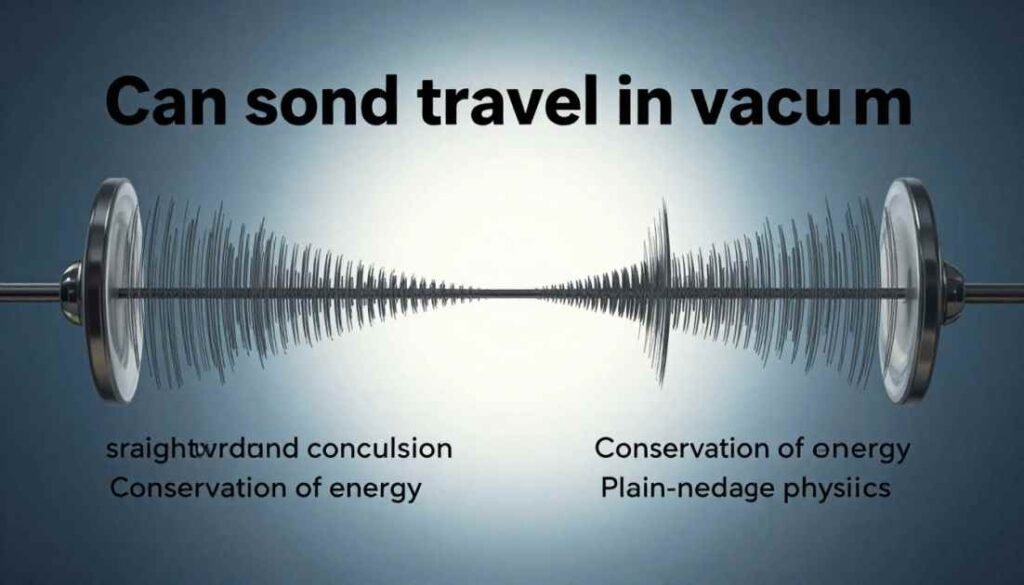
Sound waves are like ripples in a pond, but instead of water, they disturb air molecules. When something vibrates, like a guitar string, it compresses and releases the particles nearby, creating pressure changes that propagate outward.
Basics of Sound Waves
Every sound wave has key properties:
- Frequency: How many waves per second, affecting pitch (high or low).
- Amplitude: Wave height, determining volume (loud or soft).
- Wavelength: Distance between wave crests.
- Speed: How fast it moves, varying by medium.
In air at room temperature, sound travels about 343 meters per second. But change the medium, and everything shifts.
What Is a Vacuum?
A vacuum is a space devoid of matter, with no atoms or molecules. In labs, we create partial vacuums by pumping out air, but perfect vacuums are rare, even in space, where particles are sparse.
Why does this matter for sound? Without molecules to bump into, vibrations can’t chain-react. It’s like trying to start a wave in an empty stadium—no fans to pass it along.
Space is a near-vacuum, with pressures billions of times lower than Earth’s atmosphere. That’s why it’s silent up there.
Why Sound Requires a Medium
Can sound travel in vacuum give reason? Here’s the core explanation: Sound is a longitudinal wave, meaning particles oscillate in the direction of the wave. In a medium, one particle hits the next, transferring energy.
In vacuum:
- No particles = no collisions.
- Energy dissipates without propagating.
Compared to light, an electromagnetic wave doesn’t need a medium to travel; it travels well in vacuum. That’s why we see stars but don’t hear them.
Exceptions exist at quantum levels or with special materials, but for audible sound, a medium is essential.
The Bell Jar Experiment
This classic demo proves sound needs air. Place a ringing bell in a glass jar connected to a vacuum pump. As air is removed, the sound fades to inaudibility, even though the bell still vibrates visibly.
Key steps:
- Bell rings loudly in an air-filled jar.
- Pump removes air, creating a partial vacuum.
- Sound diminishes to silence.
- Reintroduce air, and sound returns.
Why? Air molecules carry the vibrations to the jar’s walls and our ears. Without air, vibrations stay local to the bell. Some faint sound might remain due to imperfect vacuum or conduction through supports, but it’s minimal.
This experiment, dating back centuries, is a staple in physics classes worldwide.
Sound Travel in Air, Water, and Solids
Sound behaves differently in different media due to molecular density and elasticity.
Speed in Different Media
Sound travels fastest in solids, then in liquids, then in gases. Why? Closer molecules transfer vibrations quickly.
Here’s a table comparing speeds:
Medium Speed (m/s) Example
Air (20°C) 343 Conversation
Water 1480 Underwater echoes
Steel 5960 Train on tracks
Wood 3850 Knocking on the door
Glass 4540 Tapping window
In the air, molecules are spread out, so sound travels more slowly. In water, denser packing speeds it up by about 4 times. Solids like metals have rigid structures, allowing even quicker travel—up to 17 times faster than air.
Practical Examples
- Air: We hear thunder after seeing lightning because sound lags light.
- Water: Whales communicate over vast distances; sound carries far.
- Solids: Put your ear to a rail—you’ll hear an approaching train sooner than in the air.
These differences highlight why sound engineering varies by environment, like concert halls (air) vs. submarines (water).
Silence in Space: Vacuum Effects
In space, the vacuum means no sound propagation. Astronauts on spacewalks hear only their breathing or suit noises via conduction. Explosions? Silent, despite dramatic visuals.
This silence affects exploration:
- Communication relies on radio waves.
- No audible warnings from debris or engines.
Yet, space isn’t perfectly empty—sparse gas clouds can carry faint sounds over huge distances, but nothing humans hear.
Debunking Movie Myths on Sound in a Vacuum
Sci-fi films often ignore physics for the sake of excitement. Think Star Wars: Laser blasts and engine roars in space? Impossible.
Common myths:
- Explosions booming: No air, no shockwave sound.
- Ships whooshing by: Vacuum blocks it.
- Screams in space: As Alien got right, “In space, no one can hear you scream.”
Why do movies do this? Sound adds drama. Silent battles feel eerie, but directors prioritize audience engagement. Exceptions like 2001: A Space Odyssey embrace the quiet, heightening tension.
Reality: Space combat would be visually stunning but audibly null.
Acoustic Tunneling: Recent Discovery
Here’s the exciting update: In 2023, physicists at the University of Jyväskylä showed sound can tunnel across vacuum gaps using piezoelectric materials. These crystals convert vibrations into electric fields, which propagate through the vacuum and recreate sound on the other side.
Conditions:
- Gap smaller than sound wavelength.
- Works for audio, ultrasound, and hypersound.
- Gaps scale down with higher frequencies.
This isn’t everyday sound travel but a quantum-like effect. It’s like a sound jumping a hurdle via electricity.
Implications? Revolutionize tiny devices.
Technological Implications
This tunneling discovery has big potential.
Microelectronics and MEMS
In smartphones, microelectromechanical systems (MEMS) like microphones could use vacuum-insulated parts for better performance, reducing noise interference.
Heat Control
Sound waves carry heat (phonons). Tunneling allows precise heat management in chips, preventing overheating in dense electronics.
Ultrasound Tech
Medical imaging could improve with vacuum-gapped sensors, enhancing resolution.
Future Applications
- Quantum computing: Isolate components while transmitting signals.
- Space tech: Better sensors in vacuum environments.
- Nano-devices: Efficient energy transfer across gaps.
As gaps shrink to the nanoscale, efficiency rises. This bridges classical physics and quantum effects, opening new engineering frontiers.
Key Takeaways
To sum up the essentials:
- Sound needs a medium; a vacuum generally blocks it.
- Exceptions via tunneling in special materials.
- Faster in solids than liquids or gases.
- Movies often fake space sounds for fun.
- Experiments like the bell jar prove the point.
Remember these for your next science chat.
Final Thoughts
So, can sound travel in vacuum? Mostly no, but science keeps evolving. From basic waves to tunneling breakthroughs, understanding sound reveals our world’s mechanics. Next time you watch a space flick, smile at the fictional booms—reality’s silence is profound. Stay curious; who knows what discoveries await?
FAQs
Can sound travel in vacuum explain?
Sound waves are mechanical and need particles to vibrate through. Vacuum has none, so no travel. Tunneling exceptions exist with piezoelectric setups.
Can sound travel in vacuum give reason?
Reason: No medium for particle compression and rarefaction. Energy can’t propagate without collisions.
Can sound travel in vacuum yes or no?
No, in standard conditions. Yes, via acoustic tunneling across tiny gaps in specific materials.
How fast does sound travel in water vs. air?
About 1480 m/s in water, 343 m/s in air—over four times faster due to density.
Why is space silent?
Near-vacuum prevents sound waves from forming or traveling.
What is the bell jar experiment?
Ringing bell in jar; remove air, sound vanishes, proving medium necessity.
Are movie space sounds accurate?
No, added for entertainment; real space is quiet.
What is acoustic tunneling?
Sound jumping vacuum via electric fields in piezoelectric crystals, for small gaps.
How does the medium affect sound speed?
Denser, more elastic mediums speed it up: solids > liquids > gases.