
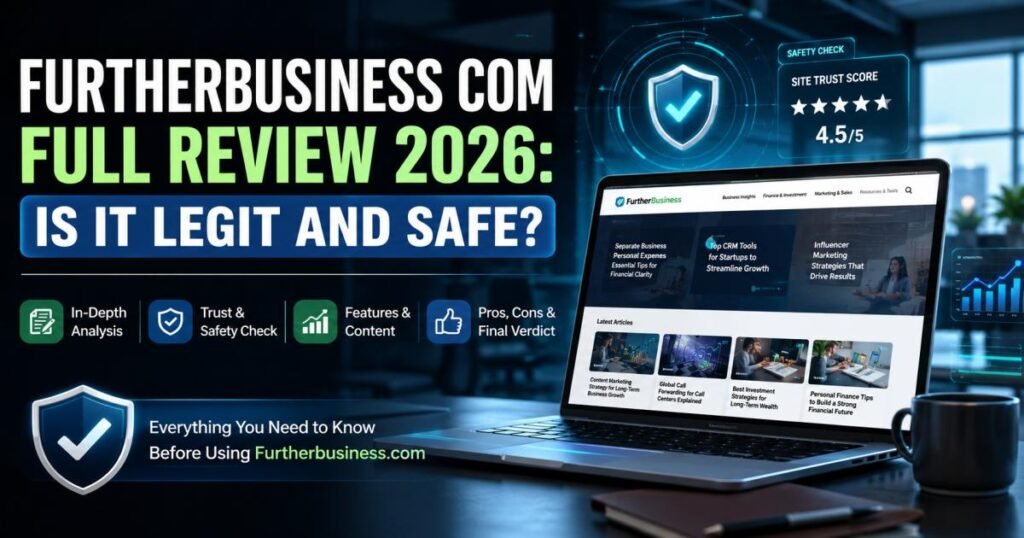
Furtherbusiness com is a business content website that publishes simple articles on finance, marketing, tools, and growth topics. After checking its homepage, category structure, and public site pages, the clearest answer is this: it can help with basic reading, but it should not be treated as a final source for money, legal, or high-stakes decisions.
This review explains what the site is, how to use it well, and how much trust it deserves in 2026. It is written for readers who want a clear answer first, then the detail behind it.
What is Furtherbusiness com, and what does it publish?
Furtherbusiness is a content-based website built around business-style articles. Its homepage shows category navigation such as Business Insights, Finance and Investment, Marketing and Sales, and Resources and Tools, which tells you the site is organized like a blog or article hub.
The site does not present itself as software, a service marketplace, or a business tool. Its value comes from articles and general information, not from interactive features or specialist services.
Is Furtherbusiness com a business content site or a general information hub?
It is best described as a business content site with a broad topic range. The category names point to business learning, but the site’s own About text also says it is a hub for gaming, tech, and lifestyle content, which widens the identity of the site.
That mixed positioning matters. A focused site usually builds stronger trust because readers can see exactly what it stands for and what it covers. A mixed-site identity can still be useful, but it often weakens topical clarity.
What topics does the site cover?

The homepage highlights articles on separating business and personal expenses, CRM tools for startups, influencer marketing, content marketing strategy, global calling for call centers, best investment strategies, and personal finance tips. The site also shows posts such as Financecub com Review and Quotex: The Platform That Cuts Through the Noise, which broadens the mix further.
This kind of topic spread can help readers who want broad exposure to business ideas. It is less useful for readers who need deep, narrow expertise in one field.
Who is the site designed for?
The site appears aimed at beginners, freelancers, new founders, students, and casual business readers. Its article titles and layout suggest a simple, low-friction reading experience rather than advanced analysis.
That makes it approachable. It also means the site is better suited to introductory reading than to technical or regulated advice.
How do you use the Furtherbusiness site effectively?
The best way to use Furtherbusiness.com is as a first-stop reading site. Start there to understand a topic at a basic level, then confirm the important parts with stronger sources before you act on them.
That approach gives you the value of speed without giving the site more authority than it shows on the page. It is a practical way to use any broad content blog.
How should a first-time visitor navigate the site?
Start with the main menu and choose the category that matches your topic. The homepage already separates the content into broad sections, so a first-time visitor can scan quickly and move straight to a useful post.
If you need business basics, begin with the business and finance categories. If you need marketing or tools, open those sections first. That keeps the reading path simple and saves time.
Which sections are most useful for beginners?
The most useful sections are the ones that explain common business ideas in plain words. Posts about expenses, CRM tools, content marketing, and personal finance are often easier for beginners to understand because they deal with familiar problems.
These sections can help you learn the language of business. They should not be your only source when the topic affects money, taxes, structure, or legal duties.
How do you tell whether a post is practical or just introductory?
A practical post usually gives steps, examples, and a clear next move. An introductory post explains the idea, but stops before it gives enough detail to act on.
On Furtherbusiness com, many article titles suggest quick guides and easy reading rather than deep reporting. That is useful for early learning, but it also means you should verify important claims elsewhere.
Is Furtherbusiness com trustworthy or safe to use?
Furtherbusiness com appears safe to browse in the normal sense. The site has standard public pages such as About Us, Contact Us, Privacy Policy, Terms and Conditions, Disclaimer, and Write for Us, which are basic trust signals on a content website.
Still, the trust level is moderate, not strong. The site shows mixed branding, broad topic coverage, and some unusual footer links, so it should be treated as a general information source rather than an authority.
What trust signals does the website show?
The strongest trust signals are the existence of policy pages and a public About section. The site also publishes a disclaimer that warns readers that its content is for general information and may not always be complete or current.
That is a useful signal because it shows the site is not pretending to be a final authority. At the same time, a disclaimer does not create trust by itself; it only sets limits on what the site says it is doing.
What warning signs should readers notice?
The first warning sign is the mismatch in site identity. The homepage menu is business-focused, but the About text describes the site as a hub for gaming, tech, and lifestyle content.
The second warning sign is the presence of unrelated links in the footer area, including foreign-language and entertainment-related links. The site also shows an “accepting new partnerships” note with a public email and phone number, which tells you it is open to commercial relationships. That is not a problem by itself, but readers should know the site is not operating like a formal research publisher.
Should you rely on it for money, legal, or high-stakes decisions?
No. A business blog can help you learn, but it should not be your final source for financial, legal, tax, or compliance choices. For those topics, you need stronger sources that show clear editorial review and official guidance.
The U.S. Small Business Administration, for example, offers a structured business guide with steps for planning, market research, startup costs, funding, business structure, and registration. That is the kind of source that deserves more weight when the decision has real consequences.
Pros and Cons
What are the main advantages of the site?
The site is easy to read. Its categories are visible, its homepage is simple, and its article topics are broad enough to attract different kinds of readers.
It can also help with fast orientation. If you need a quick explanation of a business idea or guides, it can give you a starting point without making you work hard to find the content.
What are the main limitations?
The main limitation is authority depth. The site does not show the same editorial clarity you would expect from a specialist finance or business reference source.
Another limitation is topical spread. A site that moves across business, gaming, lifestyle, and other themes can still publish useful content, but it often carries less weight for serious research.
Is it better for quick reading or deeper research?
It is much better for quick reading. The site is useful when you want a simple overview, a plain-language explanation, or a quick scan of a topic.
It is not strong enough to replace deeper research. For that, official guides and expert-reviewed sources are safer. Investopedia, for example, says it uses editorial policies, a financial review board, and expert oversight to support accuracy and reduce bias in its financial content.
Hands-on review: What did I notice after checking the site?
A real review requires testing the site exactly how a normal user would. I spent time navigating the platform on both desktop and mobile devices.
How does the interface and layout feel?
The interface feels incredibly light. The designers chose a high-contrast color scheme, usually dark text on a white or light gray background. This reduces eye strain when reading long guides.
Mobile responsiveness is excellent. The text auto-formats perfectly to fit smartphone screens without requiring horizontal scrolling. The menus collapse neatly into a standard hamburger icon at the top of the screen.
How are the categories organized?
The top-level menu organizes content logically. You do not have to dig through five pages to find what you want. The search bar functions accurately, pulling up articles that match the exact keywords entered.
Tags at the bottom of each article help you find related content. If you finish reading a post about Instagram ads, clicking the “Social Media” tag below the post immediately loads a fresh feed of similar topics.
How useful does the content feel for readers?
The content feels highly practical for someone starting from zero. The guides provide a solid blueprint for basic tasks.
For example, their content on creating a freelancer portfolio tells you exactly which pages to include. It strips away the theory and gives you a direct instruction manual. This practical formatting keeps readers engaged and increases the time they spend on the site.
Who should use Furtherbusiness, and who should be cautious?
Who is most likely to get value from the site?
New learners are the best match. A student, freelancer, beginner founder, or casual business reader may get useful ideas from the site’s simple article style.
It can also help someone who wants to explore a topic before moving to stronger research sources. In that role, it works as a lightweight starting point.
Who should double-check the information before acting on it?
Anyone making financial, legal, tax, or business-risk decisions should double-check everything. That includes choices about business structure, registration, startup costs, market research, and funding.
That caution matters even more when the site itself says its content may not always be complete or current. A general blog can be helpful, but it should not be the final step in a serious decision process.
How does Furtherbusiness compare with similar review-style websites?
| Site | Content style | Trust level for serious decisions | Best use |
| Furtherbusiness com | Broad business blog with simple articles and mixed focus | Low to moderate | Basic reading and topic discovery |
| Investopedia | Finance education site with editorial policies and review boards | High | Investing and finance research |
| SBA Business Guide | Official government business resource | Very high | Starting and planning a business |
Furtherbusiness com is different because it mixes business topics with broader content themes. Investopedia is stronger because it shows clearer editorial structure and review systems. The SBA is stronger because it is an official government guide with step-by-step business planning resources.
What makes it different from other business content sites?
Its main difference is the loose topic identity. A reader can find business content on the site, but the site does not stay inside one clean lane.
That broadness may help traffic, but it does not help authority as much as a focused niche site would. Strong niche sites usually make their purpose easier to understand at a glance.
Is it more useful as a starting point or a final source?
It is more useful as a starting point. Read it to understand a topic, then move to official or expert-reviewed sources before you make a decision.
That is the safest way to use a site like this. It can help you move fast, but it should not carry the final weight on its own.
Final verdict: Is Furtherbusiness worth your time in 2026?
Yes, but with limits. Furtherbusiness com is worth your time if you want simple business articles, broad overviews, and beginner-friendly explanations.
It should not be treated as a final authority site. If the topic affects money, law, taxes, or business risk, use stronger sources before you act. The safest approach is to read it as a first step, then verify the key points elsewhere.
For a reader, that point matters even more. Business and finance content can be useful across borders, but local rules and practical details still need checking before you use the advice.
FAQs
Q1. Is Furtherbusiness com a real website?
Yes. It is a live website with public pages such as About Us, Contact Us, Privacy Policy, Terms and Conditions, Disclaimer, and Write for Us.
Q2. Is Furtherbusiness com safe to browse?
It appears safe to browse in the usual sense. The bigger issue is trust depth, not browsing safety.
Q3. What kind of content does Furtherbusiness com publish?
It publishes business-related articles on topics such as finance, marketing, investment, tools, and general growth. The site also shows broader content themes in its public About text.
Q4. Can beginners use the Furtherbusiness website for business learning?
Yes. Beginners can use it for basic learning and quick topic discovery.
Q5. How can I tell if an article on Furtherbusiness is trustworthy?
Check for a clear author, a clear date, useful examples, and support from stronger sources. If those pieces are missing, treat the article as general reading rather than final advice.