
Software and apps WebBizMagnet is the software coverage on webbizmagnet.com, an online publication that writes about business tools, productivity apps, and automation. You read it to learn about tools. You do not buy or download anything from it.
The answer has one limit. Public information about the site is thin, and most of it comes from the site’s own press material. So this guide sticks to what is documented. Then it gives you a method that works for any tool: use a discovery site to build a shortlist, and settle the choice with a one-week test on real work. That method matters more than any single recommendation, and it returns throughout this guide.
What is Software and Apps WebBizMagnet?
It is WebBizMagnet’s coverage of software and apps, written for professionals, business owners, and readers curious about technology. An October 2025 press release describes WebBizMagnet as a digital publication that reports on software using product data and official developer information instead of opinion. A shorter overview post from April 2026 describes the same site as a resource for online business, search visibility, and digital marketing.
The two descriptions stress different things, yet they point to one audience: people who run or grow something online. Treat both with care. A press release is the site’s own message, and a brief overview post is not an independent review. Visit webbizmagnet.com and judge the writing yourself.
Readers search for the topic in several ways, including software apps webbizmagnet and “Web Biz Magnet software.” All of them lead to the same site.
What Topics Does Software and Apps WebBizMagnet Cover?
According to the press release, the coverage spans productivity, business automation, communication, and digital transformation. It also lists project management, CRM integration, workflow coordination, and task automation. It mentions both mobile utilities and desktop programs. It also says the site spotlights newer or niche products that large review sites often skip.
These topics match the problems most small businesses face: tracking work, storing customer details, sharing files, and trimming repetitive tasks. A freelance bookkeeper, for example, needs invoicing and client messaging tools. A three-person agency needs project management tools and a shared CRM. Site content changes, so check the live categories before you rely on any description, including this one.
How WebBizMagnet Helps Readers Discover Digital Tools
It helps most at the shortlist stage. Discovery is the hard part of buying software. App stores favor products with big ad budgets, and many “best software” lists exist to earn affiliate commissions. A publication that surfaces smaller or newer tools and bases its summaries on official product information can save you hours.
A good summary tells you what a tool does, who it suits, and what problem it solves. That lets you rule options in or out before you open a pricing page or create an account. Check the publication date too. A review from two years ago may describe a product that has changed its features or price.
Then comes the part no article can do for you. Pick two or three tools from your shortlist and run the one-week test: use each one on a real task for seven days.
How to Find the Right Software and Apps for Your Needs
The best software for a small business is the one the team keeps using after the first month. Here is how to choose business software without guesswork.
- Write the problem in one sentence, such as “we forget to follow up with clients.”
- List your must-haves and your nice-to-haves. Keep the first list short.
- Shortlist two or three tools. Ten options usually end in no decision.
- Run the one-week test. Use each tool on a real task, with a free trial or free plan.
- Ask the people who will use it daily how it felt.
- Add up the yearly cost, including extra users, add-ons, and payment fees.
Skipping steps four and five is a typical reason businesses pay for software nobody opens.
Popular Types of Digital Tools Worth Exploring
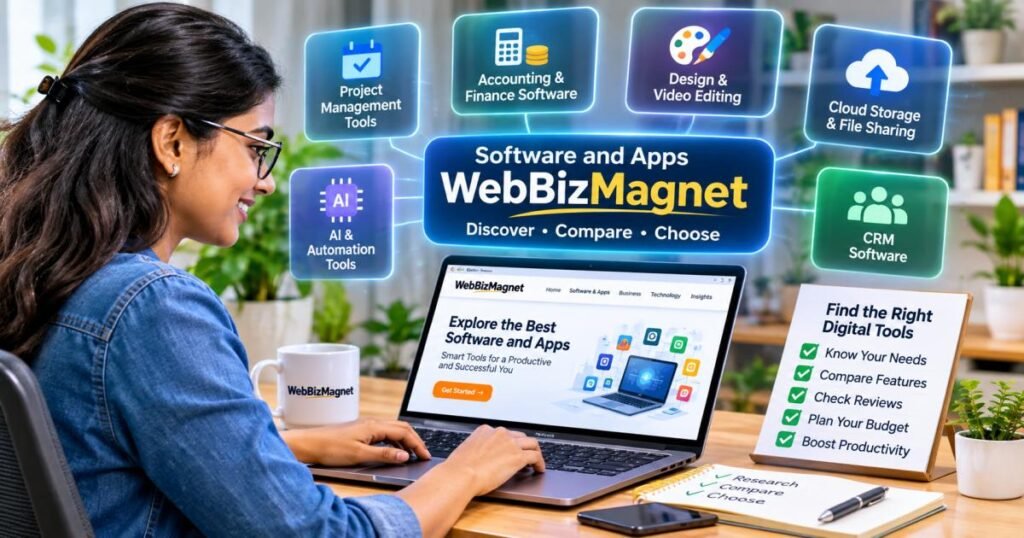
Six categories come up most often, from productivity apps for business teams to CRM software. Each one has a few checks worth making before you commit.
Project Management and Productivity Applications
Project management tools track tasks, deadlines, and owners. Trello, Asana, Notion, and ClickUp are popular examples, and both Trello and Notion offer free plans. A small team usually needs only boards, due dates, and comments. Tools packed with dozens of features often go unused because setup takes too long. Look for a good mobile app, since people often update tasks from their phones.
Accounting and Financial Management Software
Accounting software handles invoices, expenses, and tax records. Tally and Zoho Books are common choices among Indian businesses, and both support GST invoicing. QuickBooks is widely used in the United States. In any other country, confirm that the tool follows your local tax rules. Look for two-factor login, automatic backups, and easy export of your records. Ask your accountant which tool they already work with.
Graphic Design and Video Editing Tools
Canva suits social media graphics and presentations, and it has a free plan. DaVinci Resolve offers a free version for serious video editing. CapCut is a popular phone app for short videos. Video editing needs a capable computer, so read the system requirements first. If your device is older, a browser-based tool may run better.
Cloud Storage and File-Sharing Applications
Google Drive, OneDrive, and Dropbox store files online and share them with others. Google gives every account 15 GB of free storage, shared across Drive, Gmail, and Photos. Compare free limits, sharing permissions, offline access, and how well each tool syncs on a slow connection. Set sensitive files, such as contracts and invoices, to restricted access instead of “anyone with the link.”
Artificial Intelligence and Automation Tools
Workflow automation tools such as Zapier and Make connect apps so routine work runs on its own. A form entry, for example, can land in a spreadsheet and trigger a confirmation email. AI assistants help with drafting, summarizing, and brainstorming. Start with one repetitive task. Read the data policy before you paste client details into any AI tool, and review every output before it reaches a customer.
Customer Relationship Management Software
CRM software keeps contacts, conversations, and deals in one place. HubSpot CRM, Zoho CRM, and Freshsales are well-known options, and HubSpot offers a free CRM. Check how easily you can import contacts now and export them later. Many customers in India prefer WhatsApp, so see whether the CRM connects to it.
What to Consider Before Choosing or Installing Software
Check five things before you install anything: the source, the permissions, compatibility, support, and recent reviews.
Download only from an official app store or the developer’s website. Cracked copies of paid programs are a typical route for malware. Next, read the permissions. A flashlight app has no reason to ask for your contacts. Skim the privacy policy to see what data the tool collects and whether you can delete it.
Then confirm the tool runs on your device, and see when it last received an update. An app untouched for a year or more may carry unpatched security flaws. Finally, read recent user reviews, especially the critical ones, and see whether the company answers support questions.
Free vs. Paid Software: Which Option Is Better?
Neither is better by default. Free software suits learning and light use. Paid software suits the tools your work depends on. The choice turns on what a failure would cost you.
Advantages of Free Software and Applications
Free tools let you learn without financial risk. Open-source programs such as LibreOffice prove that free can still be capable. Many free plans cover a freelancer or a new business for months. The trade-offs are typically feature limits, ads, slower support, and the chance that the vendor changes its terms later.
Benefits of Investing in Premium Tools
Paid plans typically add priority support, stronger security controls, more integrations, higher usage limits, and team features such as permissions and shared workspaces. If a tool saves you several hours a week or protects important data, the fee is easy to justify. Vendors who earn money from subscribers also have a clear reason to keep improving the product.
Understanding Free Trials and Freemium Plans
A free trial gives full access for a limited time, typically a few days to a month. A freemium plan stays free but caps features or usage. Both suit the one-week test. Take three precautions. Many trials ask for a card and renew automatically, so set a reminder before the end date. Export anything you create if you decide not to continue. And test on real work, not sample data.
Choosing Software Based on Your Budget
Start free, and pay only when a limit costs you time or money. Set a monthly software budget and hold to it. Annual plans are usually cheaper, but try a monthly plan first so a bad fit does not lock you in. If a tool charges in dollars, exchange-rate swings can raise your cost over time, so look for local-currency pricing.
How Indian and Global Users Can Choose Suitable Digital Tools
Security, support, and value matter everywhere. Payments, tax rules, and data laws depend on where you live.
In India, check payments first. Look for rupee billing and methods you already use, such as UPI or Indian cards, because foreign-currency charges add up. UPI handles billions of transactions every month, so many Indian customers expect it. Businesses registered for GST need invoicing that handles it correctly. Regional language support matters too, as does an app that works on slow mobile connections, since many people run their work from a phone. India’s Digital Personal Data Protection Act is another reason to ask where a vendor stores personal data.
Readers elsewhere face their own rules, such as GDPR in Europe, along with different tax invoices and payment methods. Time zones matter too. A vendor with support hours only in US business time may be hard to reach from Asia. Choose the tool that fits your local conditions, then run the one-week test where you actually work.
Best Practices for Using Software and Apps Effectively
Set the tool up properly, protect it, and review it often. Those three habits prevent most problems.
Change the default settings, and write down a few team rules, such as how to name files or when to update a task. Turn on two-factor authentication and use a password manager, especially for tools that hold customer or financial data.
Install updates, since they often fix security flaws. Review subscriptions every quarter and cancel what nobody uses. Back up important data and confirm you can export it, so a price rise or a shutdown does not trap you. Avoid overlap, too: three task trackers split a team’s attention.
Common Mistakes to Avoid When Selecting Digital Tools
The biggest mistake is buying on hype. A tool built for a 500-person company may be too complex and too costly for a team of five.
Skipping the one-week test is a close second. A polished sales page tells you nothing about how a tool feels on a busy Tuesday. People also install software from unofficial sites to save money, and malware can cost far more than a license. Others ignore the full price, forgetting that extra users and add-ons can double the headline number. Many never check data export, which makes switching painful later. Trusting a single review is another trap, since some reviews are sponsored. Finally, collecting too many tools leaves each one half used.
Why Explore Software and Apps WebBizMagnet?
Explore it if you want a starting point for finding business software. Software and apps WebBizMagnet focuses on software instead of general tech news, says it highlights newer and lesser-known tools, and aims at working professionals and business owners.
Keep the limits in mind. Public detail about the site is thin, so treat it as one input. Cross-check what you read against the developer’s official pages, independent review platforms, and real user feedback. Then run the one-week test. That sequence protects you better than trusting any single source.
This guide draws on the site’s public descriptions and on the publicly listed features of the tools named. Prices and features change, so confirm current details on each vendor’s website.
Final Thoughts
Software and apps WebBizMagnet works best as a discovery resource. It covers business software, productivity tools, and automation, and it shows interest in lesser-known products. It can surface options you would miss, but it cannot choose for you.
The choice belongs to you and to a simple routine: define the problem, build a shortlist of two or three tools, and run the one-week test on real work. Protect your data, watch your costs, and keep your toolset small. That routine works in India and everywhere else, and it beats any list of recommended apps.
FAQs
What Is Software and Apps WebBizMagnet?
Software and apps WebBizMagnet is the software coverage on webbizmagnet.com, a digital publication about business tools, productivity apps, and automation. It is a place to read about tools, not a store. Public details are limited, so visit the site to see its current content.
What Types of Software Does WebBizMagnet Cover?
Its press release lists productivity, business automation, communication, project management, CRM integration, workflow coordination, and task automation. It mentions mobile and desktop apps, plus newer niche tools. Anyone searching for software apps webbizmagnet will find a broad business-software scope, not one narrow category.
Is WebBizMagnet Useful for Small Business Owners?
It can be, as a discovery source. Its listed topics, such as project management, CRM, and automation, match what small businesses need most. Use it to build a shortlist of two or three tools, run a one-week test, and confirm pricing on each developer’s site.
Does WebBizMagnet Provide Free Software Recommendations?
Public information does not confirm a dedicated free-software section, so check the site directly for current articles. Meanwhile, most categories in this guide include a free or freemium option you can test first, such as Trello, Canva, DaVinci Resolve, and HubSpot CRM.
How Can I Choose the Right Software for My Business?
Define the problem first, list your must-have features, and shortlist two or three tools. Run a one-week test on real work with a free trial, collect feedback from daily users, and compare the full yearly cost. Check security, support, and data export before you pay.
Are Software Reviews and Recommendations Always Reliable?
No. Some reviews are sponsored, some earn affiliate commissions, and some are outdated. Look for a clear publication date, honest drawbacks, and proof that the writer used the product. Compare two or three sources, and trust your own one-week test most.
What Should I Check Before Downloading an Application?
Confirm the source is an official store or developer site. Review the permissions it requests, read the privacy policy, check the last update date, and scan recent reviews. Make sure it works on your device and operating system.